Becoming Henry V

Daniel Jose Molina brilliantly played Hal in both parts of Henry IV and the title role of Henry V At the Oregon Shakespeare Festival in 2017 & 2018. Now quarantining in the Chicago area with his wife Alejandra Escalante (who fiercely played Hotspur opposite him in Henry IV Part 1), Daniel discusses how the roles came to him, and shares how Hal’s fear of becoming king matches the actor’s fear of playing him; the importance of knowing that Hal belongs in Eastcheap and isn’t just a tourist; how to best fight imposter syndrome; passing the baton to your fellow actors; the challenge of translating Shakespeare back into English; having multiple versions of the same conversation; the value of discovering new dream roles; devising the elevator pitch of Hal’s journey; and the flattering presence of the Reduced Shakespeare Company in his actor origin story. (Length 28:56)

By austin, ago

Shakespeare’s Sonnets (Unabridged)

Paul Edmondson is the Head of Research and Knowledge and Director of the Stratford-Upon-Avon Poetry Festival for the Shakespeare Birthplace Trust and, together with Professor Sir Stanley Wells, has just published All the Sonnets of Shakespeare, which collects Shakespeare’s 154 standalone sonnets along with most of the other sonnets Shakespeare included in his plays, and arranges them all for the very first time in the order in which they were probably written. Paul discusses how he and Sir Stanley had a desire to counter the damaging (and reductive) narrative of a so-called Fair Youth and Dark Lady, and includes revelations of a lifetime of writing; recitations by request; unexpected wisdom from a relatively young poet; recognizing the difficulty of reading the sonnets; schoolboy exercises; how sonnets 50 and 51 suggest that Shakespeare wrote them while on horseback; and the possibility (probably the certainty) of leaving a lasting impact on how we understand Shakespeare’s biography. (Length 28:48)

By austin, ago

Madhuri Shekar, Storyteller

Award-winning playwright, audio dramatist, and now screenwriter Madhuri Shekar is an alum of Julliard’s playwriting program and has an MFA from USC in Dramatic Writing and a dual Master’s degree in Global Media and Communications from USC and the London School of Economics. Madhuri was awarded the 2020 Lanford Wilson Playwriting Award and her audio drama Evil Eye won the 2020 Audie Award for Best Original Work, and now Evil Eye has been turned into a movie for Amazon Prime. Madhuri talks about how she first started writing stories as a child and discusses our shared Bay Area roots; how she felt seen at a performance of The Complete Works of William Shakespeare (abridged); the gift of parental encouragement; the perfection of a scary movie directed by identical twins; the marvel of accurate trailers; huge love for (and the difficulty of achieving) genre tonal shifts; the challenge of performing in empty space; a time to slow down; and the power of theatre and the importance of artist safety. ALSO FEATURING: Our unabridged joy at being a reduced part of Madhuri’s origin story! (Length 22:06) 

By austin, ago

Juliet To Hotspur

Character actor Alejandra Escalante has played ingenues at the Goodman Theatre in Chicago (Isabella, Measure For Measure), American Repertory Theatre in Boston (Desdemona, Othello), and for five seasons at the Oregon Shakespeare Festival (Juliet, Romeo and Juliet; Miranda, The Tempest; Princess of France, Love’s Labor’s Lost) where she also played gallant Hotspur in Henry IV, Part 1. Blessed with both the ability and the opportunity to play that kind of range, Alejandra talks about the perils and wonder of being a character actor trapped in an ingenue’s body; her initial reaction to being offered the role of Harry Percy; studying and then copying big ol’ barrel-chested dudes; how some of the most wonderful and successful actors never went to college theatre programs; the desire to revisit certain roles; and the joys of working with your former fiancé/now husband. (Length 18:43) (Pictured: Alejandra Escalante as Juliet and Hotspur in the Oregon Shakespeare Festival productions of Romeo and Juliet and Henry IV, Part 1. Also pictured: Daniel José Molina as Romeo.)

By austin, ago

Here Are Frangela

Frances Callier and Angela V. Shelton, better known as Frangela, host the essential funny political podcast The Final Word and this Saturday night September 26, 2020, are performing as part of Stephanie Miller’s Sexy Liberal Virtual Tour, appearing right in your living room (on your computer)! Frances and Angela talk about how they joined comedy forces and share tips about the importance of using your voices; bringing the funny to the people; mutual Second City origins; memories of the TBS pilot The Week Reduced; the myth of world hunger; finding comic angles; possible spoilers to Star Trek: Discovery, the valuable bond of having opinions about everything; the importance of remembering that we have options and things don’t need to be this way; and the cathartic release of breaking crockery. (Length 22:04)

By austin, ago

Hartford Stage Company

Melia Bensussen (l) and Cynthia Rider, respectively the Artistic and Managing Directors of the Hartford Stage Company, talk about the history of their multiple Tony-winning institution, and how they are managing and programming to reflect the various crises hitting their theatre specifically and the American theatre industry generally. Featuring a surprising number of laughs; gratitude at being in charge of an institution during a pandemic; the difficulty of hitting moving targets; the challenge of meeting the needs of multiple communities; how the best comedy is also the smartest comedy; a possible podcast scoop; some fantastic new brochure copy; and the opportunity and obligation to be of service to an audience and industry that’s battling crises on multiple fronts. (Length 19:43)

By austin, ago

The Hark Journal

Another creation born of quarantine, The Hark Journal is a daily email service that offers quotes and lessons from and features about William Shakespeare and the many people who interact with and perform Shakespeare’s plays and poems. Michael Van Osch talks about how this passion project grew out of his clothing company Bard Shirts, who we already follow on Instagram but didn’t know the two organizations were related. Featuring different kinds of storytelling, turning passion projects into growing businesses, how to sign up for this totally service, and theories about what’s next for both theatre and Shakespeare once things get back to “normal” . (Length 18:21) 

By austin, ago

Gary’s ‘Finding Joy’

Finding Joy is Gary Andrews’ book about how he dealt with the sudden and unexpected death of his wife a few years ago. Gary talks about how the book evolved from his regular #DoodleADay ritual; how the grieving process navigates a Shakespearean combination of tones. the fun he’s having producing his web series called Drawing on Shakespeare (co-hosted by Austin Tichenor); the joy of Joy’s funny walks; how we’re all experiencing different forms of grief (loss of life, loss of lifestyle, loss of careers); receiving humbling and moving testimonials; a heat-induced inability to remember one’s own CV; and ultimately how you honor the deceased by learning to laugh again. (Length 20:07)

By austin, ago

Play On Shakespeare

Lue Douthit is the creator and Executive director of Play On Shakespeare, a series of translations and adaptations of the entire Shakespeare canon written by some of the most interesting and talented playwrights working today. Lue talks about the program’s origins and aims, and underscores how these adaptations are not meant to replace Shakespeare’s originals, even though they frequently offer insight into them. Featuring the ability to treat Shakespeare as a living playwright and his works as “new plays;” the importance of putting the playwright in the room; the dangers of editing Shakespeare; how flexible these texts are; establishing rules and then bending them; the importance of contrast in Shakespeare; the genius of Shakespeare’s dramaturgy and structure; how 90% of current Shakespeare productions are already adaptations; and the bold and radical idea of giving living playwrights living wages. Recorded in February, 2020. (Length 27:39)

By austin, ago

That Shakespeare Voice

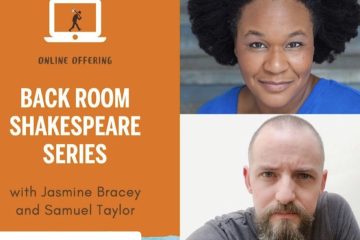
Samuel Taylor (author of My Life with the Shakespeare Cult, Blueprints for a Shakespeare Cult, and co-founder of the Back Room Shakespeare Project) and Jasmine Bracey (actor, teacher, and stakeholder in Back Room Shakes) talk about their new online class, “Spitting Out the ‘Shakespeare Voice'”, which breaks down the racist and colonizing ways in which speaking Shakespeare’s language is taught — and gives students and actors new ways of finding and utilizing their authentic voices. Featuring a breakdown (in every sense) of the teachings of Edith Skinner; delighting in Shakespeare’s language like jazz; the danger of asserting the dominance of a certain culture; the frustration of overcoming barriers to authenticity in a world of pretend; showing multiple facets of an actor’s diamond; possible textual evidence for the only two characters in the canon who can legitimately use a “mid-Atlantic” accent; the importance of not being complicit; the beauty of experiencing and speaking Shakespeare’s words authentically, especially if he’s the greatest playwright in the English-speaking western canon; the distinction of holding the mirror up to nature but not telling you what to see in it; and breaking down the idea that there’s only one correct way to speak the speech. Speak YOUR speech! (Length 33:46)

By austin, ago

Shakespeare And Trump

Jeffrey R. Wilson, a lecturer in the Writing program at Harvard University, has written the new book Shakespeare And Trump, which examines not just which Shakespearean villain or tyrant Trump most resembles, but the more richly Shakespearean world of the politicians who enable him and the populace that continues to support him. Jeff explains how reluctant he was to write the book, but how he was drawn to more of a cultural conversation (as opposed to character criticism); weak kings versus dangerous clowns; whether we’re living in one of Shakespeare’s Histories or one of his Tragedies; the trick to finding the comedy in tragedy; the value of using Shakespeare as a lens through which we can look at a specific historical moment; how using Shakespeare as a look at cultural history might reveal things more traditional history might not; and what Shakespeare play most resembles the whole year of 2020. (Length 19:06)

By austin, ago

Gender-Flipping The Shrew

In 2019, the “other RSC” — in this case, the Royal Shakespeare Company — offered a gender-flipped production of Taming of the Shrew that underscored the play’s issues of hierarchy and power. Austin Tichenor and Dee Ryan saw the production as an NT Live broadcast and are joined by GoodTickleBrain’s Mya Gosling and dramaturg Kate Pitt (who saw the production live onstage in Stratford) and they discuss how the production landed in the two formats. This fascinating book club conversation touches on the play’s wonderful mutability; the comedy of straight male vanity; whether there’s a need to “fix” it; agreeing on the game of the scene; similarities to Henry and Kate in Henry V and other troublesome couples; woman-spreading and occupying space; surprising lack of sparks; transforming modern examples of masculine anger; and how (or whether) the play changes based on how (or whether) Petruchio changes. (Length 31:35)

By austin, ago

Using Shakespeare’s Violence

Heidi Schmidt, assistant director of outreach and resident dramaturg for Colorado Shakespeare Festival, talks about Colorado Shakes’ program (now sadly on hiatus until the end of the COVID pandemic) for bringing Shakespeare into schools and using his characters and storylines as teachable moments. Featuring the dangers (and value) of the escalating pranks in Twelfth Night; the challenge and power of interdepartmental collaborations; the difference between good behavior and powerful drama; how companies gain both empathy and credibility; training actors to be teaching artists; ways of reframing Romeo and Juliet; fantastic quotes; the importance of under-promising and over-delivering; and the responsibility of giving young people (of any age) tools for dealing with crisis. (Length 20:47)

By austin, ago

West Side Story

Remember live theatre? Remember when the big story back in late February was the controversial Ivo Van Hove production of West Side Story on Broadway? Daniel Pollack-Pelzner, a professor of Shakespeare, English, and Gender Studies at Linfield College in Oregon, and a contributing writer to the New York Times and Atlantic magazine, wrote an article for the latter entitled, “Why West Side Story Abandoned Its Queer Narrative,” and, in this interview recorded on March 3, 2020, discusses the merits of the van Hove production and his insights into the original narrative. Featuring the peril of picking one’s prepositional poison; how a dorky 50s musical speaks to modern concerns about racism and police violence against communities of color; the struggle for Tony’s body; the problems with “I Feel Pretty;” Jerome Robbins’ lost play; expressing Jewish identity in the 1950s through ethnic minstrelsy; how Arthur Laurents “improved” on Shakespeare in particularly troubling ways; the rightness of questioning problematic aesthetics; the casting controversy in the recent Broadway production; and, most importantly, the feeling that when you love something you want to know and discuss everything about it. (Length 34:51)

By austin, ago

Her Majesty’s Will

Missing summer blockbusters and live outdoor Shakespeare performances? Her Majesty’s Will by novelist (and actor and fight choreographer) David Blixt is your perfect substitute! It’s a fun and thrilling adventure about the young pre-genius Will Shakespeare who becomes entangled in a deadly and hilarious misadventure when he accidentally uncovers an attempt to murder Queen Elizabeth herself. David talks about his process and inspirations; how he’s attracted to gaps and Hope & Crosby shenanigans; some deceptive cover art; the difficulty of writing a funny novel when the world is in such an unfunny place; how it all comes from research; how he finesses the facts for fictional purposes; and how truth really is sometimes stranger than fiction. (Length 20:17)

By austin, ago

More Lawrence O’Donnell

We continue our conversation with the host of MSNBC’s “The Last Word,” Lawrence O’Donnell, who talks about Mister Sterling, the show he created that starred Josh Brolin as a newly-appointed senator from California who everyone assumes is a Democrat. Lawrence shares behind-the-scenes tales of TV production; his favorite bits of direction; the real-life sources of drama and inspirations for fictional characters; the identity of the so-called “101st Senator;” how actors remember forever the parts they don’t get; how casting sessions work (and don’t work); games senate staffs play; shout-outs to great and important mentors; the possibilities and challenges of rebooting Mister Sterling or any shows like it; the extraordinary journey it took to realize multiple Tony-winning actor Audra McDonald was right for a role; things you can still shoot in quarantine; and, in a 17-year-old journalistic coup — and after 700 episodes — Finally! The RSC Podcast has its first scoop! (Length 34:06) (NOTE: Click through to find links to Part One of this interview.)

By austin, ago

Lawrence O’Donnell’s ‘Sterling’

Before he started hosting The Last Word on MSNBC in 2010, Lawrence O’Donnell was an executive producer, writer, and actor on The West Wing, and the creator, writer, and executive producer of his own show, Mister Sterling, which starred Josh Brolin and Audra McDonald in the story of an idealistic young senator who has to learn how to navigate the ins and outs of Washington DC while also conducting his personal life in the public eye. Cancelled after ten episodes, Mister Sterling featured storylines and conflicts that would find fuller expression in later seasons of The West Wing, and Lawrence talks about how the show was created and shares some fundamental Perry Mason precedents; revelations about Zoey Bartlet’s weird taste in birthday entertainment; the difficulty of writing drama set in Washington where there are now no consequences for terrible behavior; how Aaron Sorkin taught us about what drama is (or can be); what political TV zone opened up and which show filled it beautifully (and hilariously); and how he was able to pay tribute to a deep Washington legacy in Hollywood. PART ONE OF TWO. (Length 29:21)

By austin, ago

Joining The Cirkestra

The first thing you hear in our production of The Complete History of Comedy (abridged) was composed by Peter Bufano, a graduate of Clown College, a former Ringling Brothers Circus Clown, and now an assistant professor at the Berklee College of Music in Boston. Peter talks about his journey from Clown to Composer and shares some of his secrets; his comic and musical inspirations; the difficulty of hitting moving targets; finding the music in a gag; how relationship and function is most important in finding the funny; and the importance of finding and maintaining community in music, in clowning, and in life. (Length 23:39)

By austin, ago

Crafting Colbert’s Comedy

Comedy writer Tom Purcell has been working with Stephen Colbert a long time, first as the executive producer of The Colbert Report on Comedy Central and now as the executive producer of The Late Show with Stephen Colbert on CBS. (Pictured above and left, he also appears in sketches.) Tom discusses how he got started in the comedy business and what lessons if first taught him; shares boring origin stories; talks about the joy of vibing comedically; the importance of (and tips for) detaching one’s self; the value of mouth-feel; how fear is a mind-killer; how he misses the grease of unexpected interaction; and most heroically, how he eps turns today’s news — all of it, even when it’s unpleasant — into comedy. (Length 20:57)

By austin, ago

Lockdown Shakespeare Pioneer

Rob Myles, along with his producing partner Sarah Peachey, is the creator of The Show Must Go Online, which, since March 19, 2020, has been creating fully if madly rehearsed productions of Shakespeare’s canon in the order in which they were written, once a week, using actors and fight directors from all over the world. With over 100,000 views on YouTube in just 12 weeks, Rob talks about how this has become huger than he ever imagined, and how he’s learned to work in this new space; how his early studies in psychology led to understanding characters and delivering an actor-driven experience; excellent new opportunities for both audience engagement and audience research; iambic discoveries expressed in actual iambic pentameter; developing his singular obsession; shout-outs to The Barnsley Civic; being leaders in a movement rather than a company; and the realization that our moment cried out for a Rob Myles — and thankfully we have one. (Length 28:16)

By austin, ago

Globetrotting Shakespeare’s Tempest

Brave new world, indeed: Globetrotting Shakespeare is presenting a live and virtual performance of The Tempest on Saturday, July 11, 2020, featuring multiple actors in four different countries and at least six time zones from Shakespeare Napa Valley, Shakespeare by the Sea, Prague Shakespeare Company, Atlanta Shakespeare Company at the Shakespeare Tavern Playhouse, and Shakespeare at Notre Dame. Directors Jennifer King (l) and Suzanne Dean (r) discuss how the project came together; how they see challenges as opportunities to create relationships and communities through Shakespeare; how they’re seizing this opportunity to Rethink, Reframe, and Resume; the unfortunate problems with technology; how a disruptive pandemic has its own tempestuous qualities; and how we must continue finding (despite sometimes losing) our humanity in crisis. (Length 19:27)

By austin, ago

Directing Sketch Shows

Like many theaters in Chicago, Second City shut down on March 13, 2020, the same day we were scheduled to chat with actor, writer, and improviser Frank Caeti, who was directing their current production. We kept our appointment and recorded this interview with the Second City alum anyway, thinking we’d post it once everything re-opened “in a few weeks”. Ha! Nonetheless, enjoy this fascinating conversation about the process of creating a sketch show out of nothing, and listen as Frank shares Bull Durham analogies; how a director acts as a head writer; the importance of compassion, empathy, and understanding; the value of group ownership; being patient as ideas go from half-baked to more fully-baked; embracing relative autonomy; gives shout-outs to institutional memory; the endurance required for encore late-night sets; the importance of audience feedback and the uncertainty of not knowing when we might get it again; and finally, the challenge of getting used to not touching your face and how philosophers are really the forgotten victims during this pandemic. (Length 23:17) (Pictured: Frank Caeti, left, with Dan Castellaneta (The Simpsons) in The Second City’s Christmas Carol: Twist Your Dickens at the Geffen Playhouse. Photo by Craig Schwartz.)

By austin, ago

Amy Acker’s Beatrice

Amy Acker starred as Beatrice in Joss Whedon’s 2012 film version of Much Ado About Nothing, and she discusses her initial trepidation over playing this great role onscreen; how her early training at SMU and experience at American Players Theatre in Wisconsin prepared her for it; how casual play readings lead to leading roles; the value of rehearsing; the fun of doing your own stunts; the joy of working with the Joss Whedon Dancers; the differences between preparing for a play and preparing for a movie; how the Whedonverse is more Shakespearean than the (David E.) Kelleyverse; and the counterintuitive marvel (no pun intended) of how making a movie is more relaxing than taking an actual vacation. (Length 22:10)

By austin, ago

Chris Interviews Austin

It’s our 700th episode!! And because it happily coincides with the publication of Christopher Moore’s Shakespeare For Squirrels, the New York Times best-selling author turns the tables and interviews RSC co-artistic director Austin Tichenor in an epic un-reduced unabridged almost one-hour conversation. The two Fauxspeareans celebrate the release of Chris’s book by getting lost in the weeds of craft and discussing the importance of inoculating people against Shakespeareaphobia; the value of learning to keep 5-7 year olds entertained; the difficulties of working with living playwrights; understanding who got Shakespeare’s jokes and who didn’t; writing a Hitchcock adaptation for Disney animation; the dangers of unskilled labor; learning comic timing from stand-ups and Gilbert & Sullivan; using a five-act structure; the value of memorizing Shakespeare; the art of capturing Shakespeare’s exquisite mixture of tones; the perfectly understandable struggle to explain Shakespeare’s greatness; plausible explanations for why Shakespeare left his wife his second-best bed; snappy answers to listener questions; and being members in the small club of authors rewriting Shakespeare. (Length 58:17) 

By austin, ago

Shakespeare For Squirrels

Christopher Moore talks about his new comic novel, Shakespeare For Squirrels, which sees his great creation Pocket of Dog Snogging (the Fool from Shakespeare’s King Lear) stranded in the Athenian woods amongst the characters from Shakespeare’s Midsummer Night’s Dream. It’s both a breezy entertainment and a tour de force and Chris explains how the research for one novel became the basis for another one; how he satirized lovers and reconceived fairies; the importance of grounding your mechanicals; taking inspiration from both Douglas Adams and Kurt Vonnegut, Jr.; being both fantastical and of the moment; giving important agency to Cobweb; why basing your novel on a comic play is more difficult; the struggle with titles; and the challenge of being affected as much by the world one’s writing in as by the world one’s writing about. (Length 20:08)

By austin, ago

Marvel Musical Movies

What movie musical pairs best with what Marvel superhero movie? Nate Burger and Laura Rook, two married Chicago actors, are surviving the quarantine in the most entertaining and delightful of ways: Pairing Nate’s favorite Marvel superhero movies with Laura’s favorite movie musicals. Listen as they describe their method to this madness, and describe some similarities to Chris Pratt and Robert Preston; the beauty of healthy shirtless men in every genre (above); the glory of big musical numbers; which superhero movie qualifies as The Jesus Story (spoiler: most of them); the perfection of pairing Avengers: Age of Ultron with Little Shop of Horrors; surprisingly perfect pairings for Mamma Mia!, A Chorus Line, and Chitty Chitty Bang Bang; two terrific pairings for the two Ant-Man movies; and the importance of giving yourself permission to realize that enjoying fluffy garbage is the point. (Length 20:32) 

By austin, ago

Remembering Brian Dennehy

Actor Elizabeth Dennehy (left) remembers her father Brian Dennehy, “a tireless tragedian of the old school” (Chris Jones, Chicago Tribune), who passed away at the age of 81 on April 15, 2020 from cardiac arrest due to sepsis. Elizabeth shares what it was like to grow up as the great actor’s daughter and what lessons she learned about the business from him; how her father did it backwards (family first, carousing second); was inspired by Marlon Brando, Richard Burton, and Oliver Reed; grabbed both roles and audiences by the throat; grew into his looks; loved taking roles that scared him and surprising people at auditions; took command of his physicality; was powered by adrenaline; and was absolutely terrified (in a good way) by the challenge of A Touch of the Poet. (Length 23:44) (Photos courtesy of Elizabeth Dennehy.)

By austin, ago

Once Again: Mr. Brian Dennehy

“The dream is the most important part of our lives.”
Brian Dennehy, 1938-2020

We remember Brian Dennehy, the acclaimed actor who passed away last night, April 15, 2020, with this repost of our podcast interview with him from 2012, recorded during his run of Eugene O’Neill’s The Iceman Cometh at the Goodman Theatre in Chicago. Brian offers praise for his fellow actors, identifies the weather phenomenon O’Neill’s plays can best be described as, reveals what can happen when you succeed in an O’Neill play, shares who he thinks should be considered the Iron Man of the American theatre (the requirements for which sound strangely familiar), and laments the disturbing lack of 73-year-old vampires in the American cinema. (Length 19:09)

By austin, ago

Brian Stack’s Music

Second City alumnus Brian Stack (The Late Show with Stephen Colbert; Late Night and The Tonight Show with Conan O’Brien) has a knowledge of popular music that’s both broad and deep, and this week he shares with us the kind of music that gets him through tough times (like, say, a pandemic); how music intersects with comedy in surprising and hysterical ways; how Van Morrison is perfect for any occasion; his outstanding Neal Young and Michael Macdonald impressions; some comedic inspiration from Men Without Hats; and the importance of sharing your music (while not, of course, sharing your germs). (Length 23:08) 

By austin, ago

90 Sondheim Songs

Stephen Sondheim turned 90 two weeks ago and to commemorate the event (and because he’s quarantined at home like all the rest of us), NYU MFA student (and Austin’s nephew) Andrew Moorhead compiled his list of the great lyricist/composer’s top ninety songs. Like all lists like this, it provokes lively discussion about such topics as teenage discoveries; being a great artist and a great teacher; the beauty of starting ridiculous arguments; an argument for the first ten songs from Sweeney Todd; a diatribe against some (well, one) terrible and unnecessary song; uncalled-for aspersions against Andrew’s friend Jordan; reverence both genuine and irreverent; what it’s like being a Sondheim savant; some frankly scandalous opinions that Mr. Sondheim definitely won’t like; and how there isn’t much blue in The Red and the Black. Do you agree? Leave your thoughts in the comments below! (Length 21:57)

CLICK THROUGH TO SEE THE ENTIRE LIST!

By austin, ago

Shakespeare And Plague

Dr. Katy Reedy, a Visiting Assistant Professor of English at Lake Forest College who’s working on a book-length study of contagion and performance in the early modern era, discusses her research and what we can learn (and take small hope) from the plagues that forced the theaters to close in Shakespeare’s day. Featuring the importance of recognizing that this is a marathon, not a sprint; how her examination of early modern revenge plays led to research into plague and pestilence; spatial lexicons; scant evidence; scholarly suppositions; shout-outs to James Shapiro’s The Year of Lear, Stephen Greenblatt’s Will In The World, and Folger Shakespeare Library director Michael Witmore; temporal changes and the elastic nature of time; how playwrights became pamphleteers; the invention of social-distancing; and the dangers of calling attention to the pestilential potential of a communal art. (Length 22:10) 

By austin, ago

693. Phone Porn Voices

Playwright, actor, and musician Deb Hiett discusses one of her most interesting survival jobs, many years ago in the heyday of the 900 number, and how it allowed her to flex her storytelling muscles and skills as a character actress. Featuring writing and performing both audio erotica and Quarantunes™; creating stories; involuntary gag reflexes; an arsenal of accents; crafting monologues; being co-lead singer in the band Orson Welk; an extensive resume of appearances in film and television; the limited imagination of Tower Records; and the profitable power of delaying gratification. A perfect tale for these times of social distancing and self-isolation! (Length (23:10)

By austin, ago

692. J. Nicole Brooks

Actor, director, and playwright J. Nicole Brooks is the author and director of Her Honor Jane Byrne, which looks at the moment in Chicago history when its first woman mayor moved into the Cabrini-Green housing projects. Just three nights after it had its official world premiere opening at Chicago’s Lookingglass Theatre, the rest of the run was cancelled due to the restrictions being imposed around the world in the midst of this global pandemic. Brooks discusses how the play came together and how love letters to Chicago can be complicated; the value of Shakespearean echoes and wise fools; a fascination with corruption; shining light on haunted communities; getting laughs when you least expect them; decolonizing the space; losing revenue streams; surprising shout-outs to Shelley Winters in The Poseidon Adventure; and the brilliance of writing a dark comedy about kings and queens and guillotines. (Length 22:03)

By austin, ago

691. Michael Morrow’s ‘Passage’

Michael Morrow stars in the Lifeline Theatre production of Middle Passage, Charles Johnson’s National Book Award-winning novel (“a novel in the tradition of Billy Budd and Moby-Dick,” according to the New York Times Book Review) adapted by Ilesa Duncan and David Barr III (and directed by Duncan). Michael discusses how he came to be cast in this epic production, and how he’s journeyed from the DePaul University BFA program to Cincinnati Shakespeare Company, Michigan Shakespeare Festival, and beyond; how he learned to buckle swashes and paint pictures with words; what it means to Choose; the miracle of a deus ex Quackenbush; shout-outs to David Blixt and the late PJ Paparelli; and the incredibly important power of telling stories for those who can’t. (Length 20:08) (Pictured: Michael Morrow and Patrick Blashill in the Lifeline Theatre production of Middle Passage, adapted by Ilesa Duncan and David Barr III from the novel by Charles Johnson. Directed by Ilesa Duncan. Photo by Suzanne Plunkett.)

By austin, ago

690. Alchemy Of Gender

Lisa Wolpe, currently playing Cassius in Julius Caesar at Playmakers Repertory Company, is an actress, director, teacher, playwright, and producer; the founder of the Los Angeles Women’s Shakespeare Company; and the creator and performer of Shakespeare and the Alchemy of Gender, her solo show which explores the transformational power of empathy. Lisa, who’s “probably played more of Shakespeare’s male leading roles than any woman in history,”  talks about creating her show and exploring the masculine in Shakespeare’s plays; how this helped understand her father’s PTSD; reveals the true definition of ingenue; investigates a re-gendered Taming of the Shrew; and shares the urgency and importance of putting the quest in the question. (Length 23:59)

By austin, ago

689. Seven Stages Shakespeare

Dan Beaulieu and Christine Penney are the co-founders and directors of the Seven Stages Shakespeare Company, New Hampshire’s only year-round dedicated to performing the works of Shakespeare or pieces that illuminate him. Seven Stages engages with Shakespeare in a variety of contexts, including performances, readings, workshops, and podcasts, and as Christine and Dan explain the company’s mission and objectives, they talk about swimming where the fish are, such as in in parks, bars, theaters (sometimes), barns, and warehouses; give shout-outs to influential professors; reveal how musical theatre performers are frequently excellent Shakespeareans; celebrate Shakespeare with a morning zoo/sports talk-radio energy; compare Brooklyn neighborhoods; and finally — beautifully — share what happens when you get to the sixth and seventh stages of Shakespeare. Recorded LIVE at the Shakespeare Theatre Association Conference in Dallas, January 2020. (Length 20:23)

By austin, ago

688. Sonnet Man Returns

It’s The Sonnet Man! Who, disguised as mild-mannered Devon Glover, fights for truth, rhythm, and the Shakespearean way. At the recent Shakespeare Theatre Association conference, Devon spoke about his recent vow, what he’s been doing, who he’s been working with, and where he’s been teaching; the beauty of finding your voice through verse; the challenges and rewards of finding your own individual swagger; early work with Flocabulary; inspiration from the movie O; the dangers of a stagnant Devon; possible epitaphs; unexpected inspiration from Heathcliff and the Cadillac Cats; the difficulty of acting while rapping; a reduced abridgment of his fantastic article for Dramatics Magazine; and finally, what it’s like to duet and collaborate with MC Bard. Coming soon (probably) to a state near you! (Length 25:09)

By austin, ago

687. Gary Andrews’ #DoodleaDay

Gary Andrews is an animator and single dad whose #DoodleaDay visual diary chronicles his life, particularly how it transformed several years ago with the sudden death of his wife Joy (left). Gary discusses the rules he gives himself and how his daily ritual became a major part of the grieving process and a meaningful balm to an increasing number of followers and fans. Featuring touching chords, the marvel of having both talent and bandwidth, a beautiful film made from his drawings, the power of unpacking the day, the hardest thing one ever has to do, the mystery of laughter continuing through grief, how you can donate to the UK Sepsis Trust, Shakespeare being a constant, shout-outs to Fireman Sam and Horrid Henry, and connections to RSC founding member Adam Long! (Length 18:14)

By austin, ago

Livermore Shakespeare Festival

Livermore Shakespeare Festival is the thriving cultural center of the Tri-Valley in the San Francisco Bay Area, and founder and producing artistic director Lisa Tromovitch talks about how the company began and how it’s continuing to grow. Featuring the journey from parks and vineyards to a brand-new building; how working with new plays and living playwrights is great training for collaborating with William Shakespeare; how Shakespeare and theatre acts as an economic engine; and finally, the greatness of being in the so-called center of the MegaRegion! (Length 20:21) (Lisa Tromovitch; Nicole Odell and Skyler Cooper in the 2019 Livermore Shakespeare Festival production of Othello, directed by Michael Wayne Rice. Photo by Gregg Le Blanc, CumulusLight.com)

By austin, ago

John Sutton’s Will

Terry Franklin is an estate and trust lawyer who in his spare time is chronicling the story of his antebellum ancestors, John and Lucy Sutton, and the discovery of the actual document that emancipated his fourth-great-grandmother and freed her from slavery. Terry discusses his journey and the story of his family, and talks about the dangers of destructive fires; contested wills; the luck of finding thoughtful paralegals; family connections to the Tuskegee Airmen; the thrill of the (paper) chase; how fact met fiction; a fateful fascination with red sealing wax; encouraging words from Amelia Boynton Robinson; the power of prayers for the ancestors; how Lucy and her children were able “to enjoy their full and perfect freedom;” and emerging understanding of what history actually is. (Length 24:30) (Recorded Friday, January 24th 2020, the 173rd anniversary of the day John Sutton’s will was written.)

By austin, ago

Appreciating Viola Spolin

Aretha Sills discusses her grandmother, the legendary Viola Spolin, who invented an entire discipline and whose book Improvisation for the Theater is a fundamental text for generations of theatre artists. Viola’s son (and Aretha’s father) Paul Sills took Viola’s teachings “to the world,” where they became the foundation for more than sixty years of American acting and comedy. Aretha discusses Viola’s early training with Neva Boyd at the Jane Addams Hull-House in Chicago and with the Group Theatre in New York; early exposure to opera from her policeman father; how Viola’s work inspired the Playwright’s Theatre, the Compass Players, and Second City; the value of Spolin’s theatre games in de-colonizing authoritarian teaching methods; and the importance of understanding and honoring the origins of this work (play). (Length 22:47) (Photo courtesy of the Estate of Viola Spolin, www.violaspolin.org.)

By austin, ago

Personifying The Muse

New York Times best-selling author Christopher Moore talks about his best-selling novel Sacre Bleu: A Comedy d’Art, and how he weaved together the history of the color ultramarine blue, the rise of the impressionists, and the death of Vincent Van Gogh to create a wildly entertaining novel about the sometimes-comic sometimes-poignant dangers of invoking the Muse. Featuring tips from Famous Genius School; ideas begun from simple notions; misappropriating (and mispronouncing) French terms; secrets of surviving book tours; inventing more Earthly Delights; the truth of the arrival of the muse; and the joy of discovering — and then filling in — holes in history. (Length 22:38)

By austin, ago

Comparing Twelfth Nights

To celebrate Twelfth Night, we compare different productions of Shakespeare’s great comedy with Dee Ryan, adjunct professor at Northwestern University and president of the North Shore Shakespeare Society, and actress Elizabeth Dennehy, who recently directed Twelfth Night at the Los Angeles County School for the Arts. Featuring shout-outs to productions at Cincinnati Shakespeare Company; the Stratford Festival (with music by Michael Roth & Des MacAnuff), the South Australian State Theatre with Geoffrey Rush, Chicago’s Writer’s Theatre, and the Amanda Bynes film She’s The Man; how Twelfth Night got its title (and subtitle); how and when to make sure scene transitions flow as well as the play itself; the virtue of outright theft; how the play is NOT the tragedy of Malvolio; inspiration from the musical Once; Lear-like Orsinos; cleansing rains; shout-outs to Oregon Shakespeare Festival’s Oklahoma! and San Diego Repertory Theatre’s The Humans; valentine reviews; pairing Antonio and Aguecheek; the benefits of isolating your Olivia; shout-outs to Caitlin McWethy and Abby Lee (pictured above); the food chain of status-climbing; and, as ever, the promise of getting it better…next time. (Length 27:50) (Pictured: Abby Lee as Olivia, Caitlin McWethy as Viola, and cast of the Cincinnati Shakespeare Company production of Twelfth Night, directed by Austin Tichenor. Photos by Mikki Schaffner Photography.)

By austin, ago

Advice For Actors

For the last podcast of the decade, we answer the two biggest questions we’re regularly asked: What advice do you have for young actors; and when will you tour the UK again?! Featuring advice both practical and philosophical; tips for auditioning; advice from Mister Rogers; Top Ten Shakespeare Monologues; the value of learning by doing; a tiny Twitter Q&A; what kind of people you should surround yourself with; and finally, what you can do to make a UK tour happen. Special thanks to Instagram follower Zach Gillam, and Twitter followers Liz Marsden and Bob Linfors for the questions. Happy New Year! Happy New Decade!  (Length 18:36)

By austin, ago

The Reduced Shakespeare Company Christmas

Your new holiday tradition! The complete (unabridged) recording of The Reduced Shakespeare Company Christmas, produced by Connie Blaszczyk for Public Radio International in 1995, which has been unavailable for years and features Adam Long, Reed Martin, Austin Tichenor, and Matthew Croke in a special “live” recording from RSC HQ. Not to be confused with our stage production The Ultimate Christmas Show (abridged), the RSC Christmas features transmissions from Yule-Sat, Reed’s Happy Wholesome Holiday Poem, Carolers from Hell, just A Little Dickens, the incredibly helpful Carol Complaint Line, almost-25-year-old references, a very minor holiday apocalypse, 12 Tips of Christmas, our epic production of “The Complete Christmas Carol (abridged)”, an exclusive interview with Charles Dickens himself, and ultimately, inevitably, the True Meaning of Christmas. (Length 46:33)

By austin, ago

Director Robert Falls (Part 2)

This week we continue our conversation with Robert Falls, the Tony-winning artistic director of the Goodman Theatre in Chicago. In addition to being well-known for directing classics like Arthur Miller’s Death of a Salesman and Eugene O’Neill’s The Iceman Cometh and Long Day’s Journey Into Night, Bob has worked on such possibly surprising material as the Elton John and Tim Rice musical Aida, and that’s where we pick up our conversation. Featuring the joy of working with actors; collaborating with Elton John, Tim Rice, and David Henry Hwang; tales of working on John Logan’s Red, and Shakespeare’s Winter’s Tale and Measure for Measure; why and how we’re drawn to certain plays or genres; false distinctions; some terrible phrasing and important corrections; why, for all the comedies Bob directs, he may be more of a tragedian; and the dual pleasures of tearing plays apart — and an audience’s heart out. (Length 18:54) (Pictured: (l-r) Disney Theatrical’s Thomas Schumacher, Elton John, and Robert Falls in rehearsal for Aida, 2000.)

By austin, ago

Director Robert Falls

Robert Falls is the Tony-winning artistic director of the Goodman Theatre in Chicago, and after talking with several actors from his productions of Death of a Salesman (left), The Iceman Cometh, The Winter’s Tale, and Enemy of the People, we finally get to talk to the man himself. Bob discusses how he approaches his work, and how ultimately passion decides everything, but along the way gives shout-outs to Mark Larson and his invaluable book Ensemble; talks about how he finds his way into the work; shares guest appearances by Winston Churchill; reveals one or two trials by fire; enthuses about amazing introductions to Shakespeare; and tells a great story about working with Vanessa Redgrave (though probably not the story you’re thinking of). (Length 24:55)

By austin, ago

Holy Land Hamlet

It’s a podcast bar mitzvah! The Reduced Shakespeare Company Podcast became a man last week when it celebrated its 13th birthday while we were performing Hamlet’s Big Adventure! (a prequel) in Israel. To honor that special occasion, we gathered in Molly Bloom’s, Tel Aviv’s traditional Irish pub, to talk about how Israeli audiences responded to the show. Featuring universal cultural references, slowing down the pace, dealing with the heaviest sword in the world, people surprised by the number of actors, miraculous costume changes, combining parodies in a The Court Jester/Hamilton mashup, and the pleasure of pleasing both Shakespeare nerds and neophytes. (Length 23:35)

By austin, ago

Red Fox Theatre

Playwright Ellen Margolis (left )saw the Red Fox Theatre production of Catch of the Day (short-listed for Best Musical at the 2018 Edinburgh Fringe) and the experience of seeing it was as wonderful as the show itself. Ellen discusses how all the extra-theatrical elements combined to make a magical evening at the theatre even more so, and shares insights into the nature of crazy fish stories, excellent marketing materials, local hand-held guidance, uniting the audience through the power of a Van Morrison singalong, tales of Fungie the Dolphin, kindred reduced spirits, worldwide Fringe experiences, and further adventures within the comedy industrial complex. (Length 19:09)

By austin, ago

Romeo And Juliet

The current Chicago Shakespeare Theatre production of Romeo And Juliet completely reinvigorates Shakespeare’s most famous play, emphasizing frequently overlooked themes and giving events an intense urgency that accentuates both the comedy and the tragedy. Director Barbara Gaines (who’s also CST’s founding artistic director) talks about what finally drew her to the play and how she emphasized certain things while eschewing too much romanticization; how she underscores the dangers of cycles repeating endlessly; creates powerful final images: how every Shakespeare play can be improved by setting it in a high school; how she adds tension and comedy to the balcony scene; gives us a reduced history of Chicago Shakespeare Theatre; and the wonderful but maybe not too surprising relationship between Chicago Shakes and Second City. (Length 24:02) (Pictured: Brittany Bellizeare and Edgar Miguel Sanchez in Chicago Shakespeare Theater’s production of Shakespeare’s Romeo and Juliet, directed by Barbara Gaines. Photo by Liz Lauren.)

By austin, ago

Steadfast Tin Soldier

The Lookingglass Theatre Company in Chicago is remounting Mary Zimmerman’s production of The Steadfast Tin Soldier this holiday season, and the Tony-winning director and adapter herself talks to us about how the show came to life. Featuring seeking and finding, bittersweet qualities, being drawn to outsiders, staging an advent calendar, music hall influences, Masterpiece Theatre memories, colonizing the mind, actor contributions, a tribute to longtime collaborator Christopher Donahue, the value of taking a break, kitty sneezes, ending on a pun, toggling back and forth between literary and theatrical storytelling, and the value of beautiful legitimate sentiment. (Length 25:05) (Pictured: Alex Stein in the title role in the Lookingglass Theatre Company production of The Steadfast Tin Soldier, directed and adapted by Mary Zimmerman (left). Photos by Liz Lauren.)

By austin, ago

Standup Vs. Improv

Liz Allen is an improviser and teacher who, among other things, coached the improv team in Mike Birbiglia’s film Don’t Think Twice. Liz’s trip to the Mayo Clinic became an existential crisis that caused her to reflect on her work and career, and she shares with us her revelations about angels on earth, comedy with a purpose, misdiagnoses, spontaneous jokes, enriching laughs, weird complications, having a face for comedy, surviving a long night of the soul, embracing life lessons, coaching movie actors, the surprising spiritual element of joke-telling, and best of all: solid endocrine humor! (Length 20:10)

By austin, ago

Shakespeare Rocks Tonight

Shakespeare rocks every night, of course, but especially on Lou Carlozo’s new album By Me & William Shakespeare, a collection of songs in a variety of styles set to the words of the immortal dramatist poet. Lou discusses how his love of music and relationship to Shakespeare inspires this project, and reveals the dangers of over-reverence; talks about poetic goldmines and high-culture milestones; shares shout-outs to favorite inspirational teachers; and glories in the possibilities of constant reinvention. Rock on! (Length 24:39)

By austin, ago

Doug The Time-Traveler

Meet Doug Harvey (center, above), the newest member of the RSC and also the author and star of the one-man show The Time Traveler’s Guide to the Present, which earlier this summer won the Paul Koslo Memorial / MET Theatre Award at the Hollywood Fringe Festival. Doug reveals his RSC origin story and shares some live musical spaghettification; his feelings about the need for adventure and more shows about science; how a one-man show became a sci-fi romance; day gigs at LA’s Griffith Observatory; references to the darkest timelines; a couple of harmonizing triads; the Michael Faulkner conduit; growing up with Bay Area theatre like California Shakespeare Company and American Conservatory Theatre; tales of successful auditions; the importance of serious clowning; and the answer to the ultimate question: What’s the closest we have to a time machine? Not a Delorean, not Bill and Ted’s phone booth, but…a theatre. (Length 21:29) (Pictured: Austin Tichenor as the King, Doug Harvey as Hamlet, and Chad Yarish as Yorick in the Reduced Shakespeare Company production of Hamlet’s Big Adventure! (a prequel).)

By austin, ago

All About Ophelia

The RSC’s 11th stage show, Hamlet’s Big Adventure! (a prequel), is really all about Hamlet’s best friend Ophelia, at least according to Jessica Romero, who originated the role in the workshop production, and Austin Tichenor, who co-wrote the script and will be playing Ophelia this fall in California and Israel. Hear them chat about reconciling the many interpretations of Ophelia, and discuss professional memorization methods, weaponizing feelings, how one person’s comedy can be another’s tragedy, shared inspiration from Taming of the Shrew (both pirate- and commedia-themed), playing bucket-list roles, favorite Shakespeare characters, and the reality of the curse of saying the title of the Scottish Play. (Length 23:09) (Pictured: Jessica Romero as the King (with Peter Downey as Hamlet) and Ophelia (with Chad Yarish as Yorick) in the Shakespeare Napa Valley workshop of Hamlet’s Big Adventure (a prequel). Photos by Julie McClelland.)

By austin, ago